FLIGHT LAB
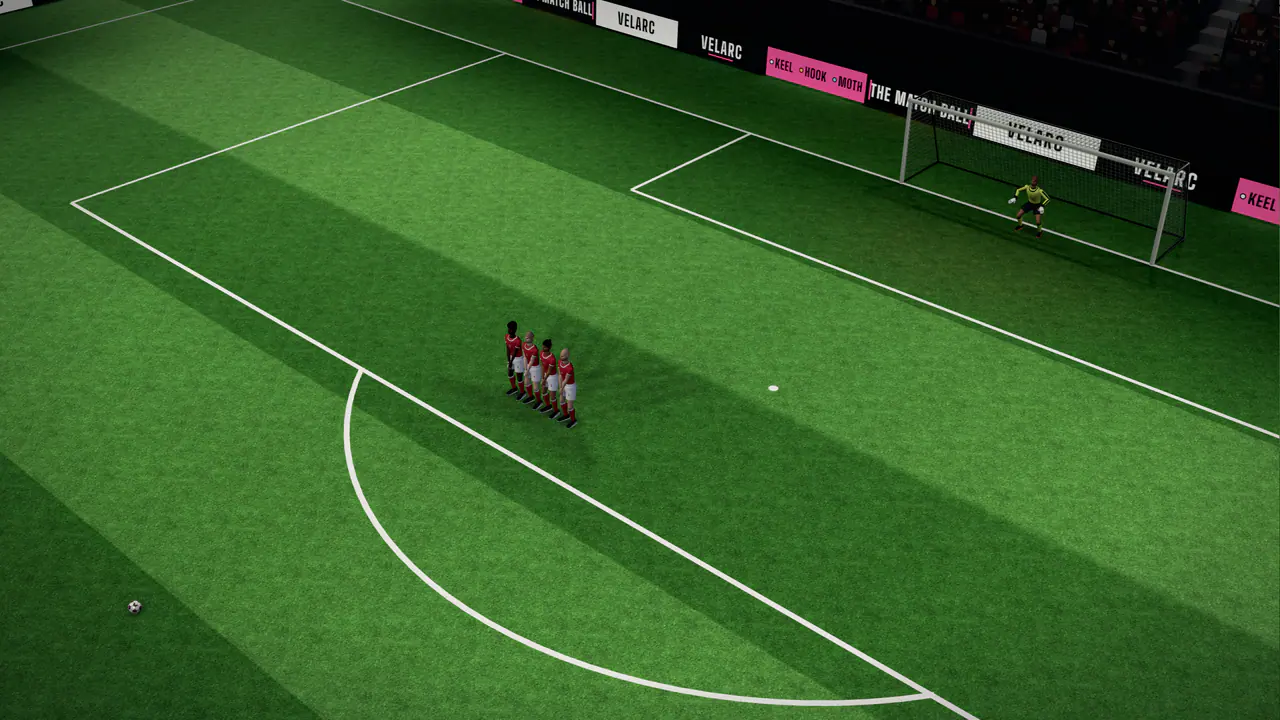
ONE SECOND FROM 24 METRES.
A driven free kick reaches the goal in about a second. What the ball does in that second depends on its surface. Velarc is a fictional brand. The air is not: every flight on this page comes from a model fitted to published wind-tunnel measurements, with the sources at the bottom.
- Keel
- Hook
- Moth
CHAPTER 1 · DRAG
1 · SEAMS DECIDE WHEN THE AIR LETS GO.
Air flowing round a ball clings to its surface, then breaks away behind it. Behind the break is a wake, and a wide wake means drag. Past a certain speed the thin layer of air on the surface turns turbulent, holds on longer, and the wake narrows: drag falls away. Seams and grooves trip that change earlier.
The Hook's deep grooves get there first: its drag is lowest at 64 km/h. The Keel follows at 70 km/h. The Moth, with the least seam, only settles at 89 km/h. Below that it is still in the middle of the change: at 61 km/h it carries 2.2× the drag of the other two. From 79 km/h up it is the slickest of the three.
| Keel | Hook | Moth | |
|---|---|---|---|
| Drag coefficient | |||
| Drag |
CHAPTER 2 · CURL
2 · SPIN BENDS IT.
A spinning ball drags the air round with it. On one side the surface runs with the flow, on the other against it; the wake is thrown one way and the ball is pushed the other. The push grows with spin and speed, and it only works well once the air is holding on to the surface: a ball back in its drag change curls less.
On our curled free kick, 94 km/h with 9 turns a second from 24 m, the Keel bends 1.3 m, the Hook 1.3 m and the Moth 0.9 m: by the time it arrives it has slowed to 52 km/h, far below the speed where the air holds on to it.
| Time to goal | Bend | Speed at goal | Spread | |
|---|---|---|---|---|
| Keel | ||||
| Hook | ||||
| Moth |
CHAPTER 3 · THE KNUCKLE
3 · NO SPIN, AND IT MOVES.
Strike a ball dead through the middle and it should fly straight. It doesn't quite. With no spin the wake peels off one side, then the other, a few times a second, and each peel shoves the ball sideways. Measured on a kicked ball, that force peaks near 2 newtons, about three and a half times a second (Hong et al., 2010).
Fifty strikes, no spin, 83 km/h, from 25 m. Where they cross the line spreads 0.12 m side to side with the Hook, 0.17 m with the Keel and 0.40 m with the Moth. In our model, one turn a second halves the Moth's wobble (0.21 m) and two turns all but stop it (0.03 m).

Crossed the line in the air Touched the grass first
CHAPTER 4 · YOUR KICK
4 · YOUR KICK, THREE BALLS.
Every kick you take in the Night Test is kept on this device until you close the tab. Here your last one flies again with each ball: same speed, same spin, same direction. No wall, no keeper, just the air.
Take a kick in the Night Test first.
Take the free kick| Time to goal | Bend | Speed at goal | Spread | |
|---|---|---|---|---|
| Keel | ||||
| Hook | ||||
| Moth |
WHERE EVERY NUMBER COMES FROM
Velarc is fictional. Its three balls fly on published measurements of three real kinds of ball: a stitched 32-panel ball, a thermally bonded 6-panel ball and a smooth ball with little seam.
- Drag
- Kiratidis & Leinweber, Eur. J. Phys. 39, 034001 (2018), fitted to wind-tunnel data from Goff, Asai & Hong, Proc. IMechE Part P 228, 233 (2014), and Hong & Asai, Sci. Rep. 4, 5068 (2014).
- Spin and curl
- Asai, Seo, Kobayashi & Sakashita, Sports Eng. 10, 101 (2007); Goff & Carré, Eur. J. Phys. 31, 775 (2010).
- The knuckle
- Hong, Chung, Nakayama & Asai, Procedia Eng. 2, 2455 (2010).
Limits
- The side force on a ball with no spin is a model tuned to measured forces, not a measurement of our balls.
- Curl is modelled within the spin range measured in the wind tunnel; we don't chart it beyond.
- Spin slows a little in flight; it changes the bend by less than a centimetre, and we don't quote it.
- Flights leave out wind, rain and altitude.


